Radiology in 2026: The Workforce Crisis Meets the AI Revolution
EHC in Becker's Hospital Review

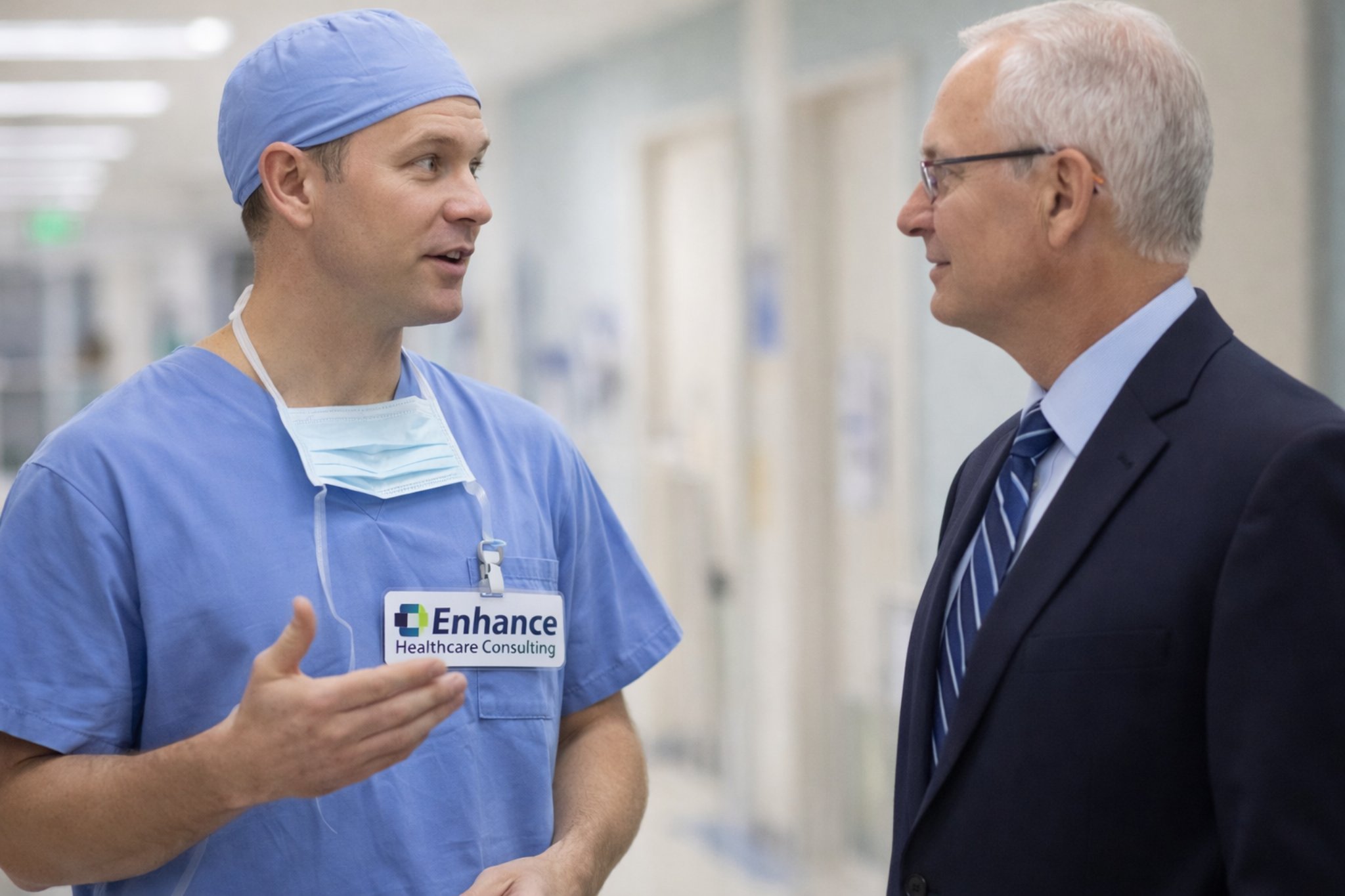
EHC in Becker’s Hospital Review
Andrew Mazzella of Enhance Healthcare Consulting recently contributed his perspective on the most significant challenges facing radiology in 2026.
Read the Becker’s Hospital Review feature → 🔗 Read the article
Radiology entered 2026 at a critical inflection point.
Imaging volumes continue to increase across hospitals, emergency departments, and outpatient imaging centers, while many healthcare organizations are struggling to maintain adequate staffing, operational performance, and financial sustainability.
Although radiology has historically adapted well to technological, clinical, and regulatory change, several forces are now converging simultaneously. Two challenges stand above the rest: a growing radiology workforce shortage and continued financial pressure occurring alongside the rapid adoption of artificial intelligence.
For radiology leaders, the challenge is no longer simply keeping pace with imaging demand. Organizations must determine how to increase capacity and productivity without creating unsustainable workloads, while simultaneously evaluating which emerging technologies can produce meaningful clinical, operational, and financial value.
Demand for diagnostic imaging continues to grow as healthcare organizations manage aging patient populations, increased utilization of advanced imaging, expanding screening programs, and greater reliance on imaging throughout the patient-care continuum.
Radiologist and imaging-professional availability, however, has not necessarily kept pace with demand.
Healthcare organizations and radiology groups are competing for radiologists and experienced technologists, with recruitment particularly challenging in certain subspecialties and geographic markets.
The consequences extend well beyond recruiting.
Insufficient staffing can affect:
What may initially appear to be a recruitment problem can therefore become an enterprise operational problem.
Healthcare organizations cannot necessarily solve increasing imaging demand simply by asking existing radiologists to interpret more studies.
Higher study volumes, increasing case complexity, overnight coverage requirements, administrative responsibilities, communication demands, and productivity expectations can place significant pressure on the existing workforce.
As a result, radiology leaders need to evaluate more than the number of radiologists employed or contracted.
Organizations should consider questions such as:
The objective should be to create a sustainable operating model rather than relying indefinitely on increasing individual physician workload.
Radiology workforce shortages have increased the importance of teleradiology.
For many organizations, remote interpretation is no longer limited to overnight preliminary reads. Teleradiology may provide subspecialty coverage, overflow capacity, weekend support, emergency coverage, and access to radiologists who are difficult to recruit locally.
However, increasing dependence on teleradiology creates its own operational and financial considerations.
Healthcare organizations need to evaluate the cost of remote coverage, turnaround expectations, communication requirements, technology integration, credentialing, quality standards, and the appropriate balance between on-site and remote radiologists.
For some organizations, the optimal solution may be a hybrid model that strategically combines local physician presence with remote interpretation resources.
Workforce challenges are occurring at the same time radiology organizations face continued financial pressure.
Reimbursement constraints combined with increasing costs for physician and technologist labor, equipment, cybersecurity, information technology, malpractice coverage, and other operating expenses can significantly affect margins.
This creates a difficult equation.
Organizations need additional capacity to meet imaging demand, but that capacity is becoming increasingly expensive to provide.
Hospitals and radiology groups therefore need a clearer understanding of the economics of their service models, including:
Increasing volume alone does not guarantee improved financial performance.
Artificial intelligence continues to generate enormous interest throughout radiology.
Potential applications include:
The strategic question for healthcare organizations, however, is changing.
Rather than asking, “Should we use AI?”, leaders increasingly need to ask:
“Where can AI create measurable value within our radiology operation?”
That distinction is critical.
The potential value of an AI application does not automatically translate into measurable operational or financial improvement.
Successful implementation may require:
A technology that performs well technically but disrupts physician workflow may produce limited value.
Similarly, an AI solution that improves a clinical process but requires substantial implementation and ongoing costs needs to be evaluated within the organization’s broader financial strategy.
For this reason, AI investments should be assessed not simply as technology purchases but as operational transformation initiatives.
One of the most important challenges surrounding AI adoption is demonstrating return on investment.
The appropriate ROI measure will depend on the technology and the problem it is intended to solve.
Potential measures could include:
Organizations should establish baseline performance before implementation whenever possible and identify the metrics that will determine whether the technology is producing the expected value.
Without clear objectives and performance measures, AI adoption can become another operating expense rather than a source of measurable improvement.
The intersection of workforce shortages and AI creates one of the most important strategic questions facing radiology in 2026:
How can organizations increase productivity without creating an unsustainable work environment?
Technology can potentially remove inefficiencies and reduce repetitive work. But using every productivity gain simply to increase physician workload risks undermining the benefits of automation.
Radiology leaders should instead evaluate whether technology can help create a more sustainable operating model—one that improves capacity while protecting quality, physician engagement, and long-term workforce retention.
This requires viewing physician well-being and operational performance as interconnected rather than competing priorities.
Workforce and financial pressures are also influencing the structure of the radiology market.
Health systems may seek greater standardization and centralization across imaging operations, while independent radiology groups may evaluate partnerships, mergers, shared infrastructure, or larger operating models.
Scale can potentially provide advantages in recruitment, subspecialty coverage, technology investment, teleradiology, administrative infrastructure, and contracting.
However, scale alone does not guarantee operational efficiency.
Organizations still need effective governance, appropriate staffing, reliable technology, strong physician relationships, and sound financial management.
The radiology organizations best positioned for the future may not necessarily be those purchasing the most technology or pushing radiologists toward the highest possible productivity.
Successful organizations will be those that align workforce strategy, technology, operations, and financial management.
That means asking:
These are operational questions as much as technological ones.
The Future of Radiology Requires Innovation and Sustainability
Radiology’s future will depend on balancing innovation with sustainability.
Workforce shortages cannot be solved solely through recruitment. Financial pressure cannot be solved solely through increased imaging volume. And artificial intelligence cannot create value simply through implementation.
Healthcare organizations need an integrated strategy that connects staffing, workflow, technology, data, and financial performance.
At Enhance Healthcare Consulting, we work with hospitals, health systems, imaging centers, and radiology practices to evaluate these challenges and develop practical strategies for improving radiology performance.
Our radiology consulting work includes operational and financial assessments, staffing and coverage strategies, workflow optimization, data benchmarking, teleradiology evaluation, revenue-cycle analysis, RIS/EMR integration, service-line growth, and evaluation of emerging technologies.
The objective is not simply to make radiology departments work faster. It is to create sustainable operating models that improve patient care, support physicians and staff, and strengthen long-term financial performance.
Written by Andrew Mazzella — Radiology Business & Operations Consultant
Andrew Mazzella is a healthcare administrator and radiology consultant with more than 25 years of experience in practice management, healthcare operations, financial management, strategic growth, and process improvement.
Since 2003, Andrew has held leadership roles in radiology management. He serves as CEO of Radiologic Associates, P.C., a private radiology group supporting hospital systems, outpatient imaging centers, and medical practices across New York, New Jersey, and Pennsylvania. Since 2016, he has also served as a Radiology Consultant with Enhance Healthcare Consulting, advising healthcare organizations on radiology operations, financial performance, practice management, and strategic growth.
Andrew is an active member of the Medical Group Management Association (MGMA) and the Radiology Business Management Association (RBMA).
[Read Andrew Mazzella’s Full Bio] | [Connect with Andrew on LinkedIn]